Can you elect your candidate president on a level playing field?
Find out in a strategy game designed by experienced campaign staff, some of whom actually worked on winning campaigns. Match your strategy against a friend, the computer or your own AI.

A level playing field
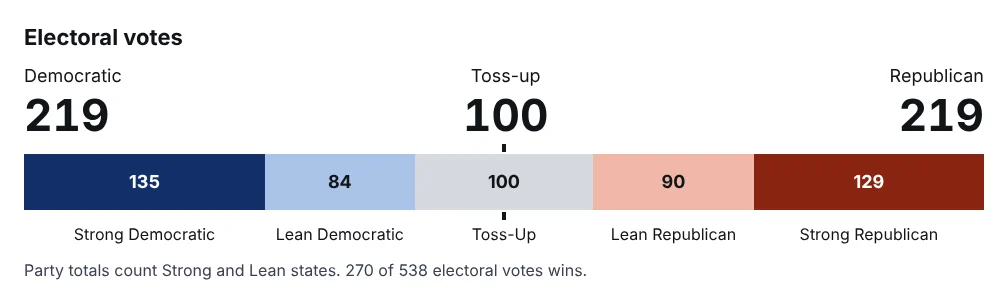
Both campaigns open with the same money, and the electoral votes start split down the middle, with the toss-up states up for grabs. Neither party gets a head start from the rules.
No plan wins every time. Pour money into advertising, and your opponent's candidate visits can drown it out. Lean on visits, and a strong field operation wears them down. Build the field operation, and the other side's advertising chips away at it. Whatever you build, your opponent has an answer, and so do you.
The campaign that wins is the one that was better managed.
Every week, the call is yours
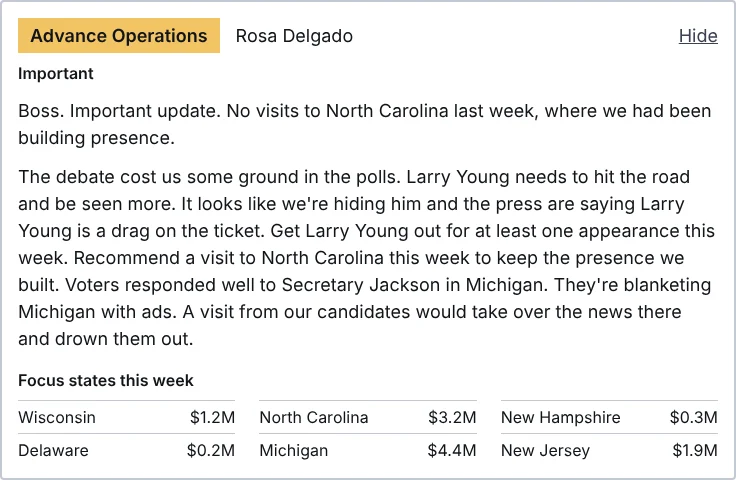
Your field director wants more money for Ohio. Your communications director says that money wins Georgia. The polls have both states within a point, and your campaign controller warns that you can't afford both and still make it to Election Day. Your opponent is deciding too, and you won't see their plan until the polls move.
Take the advice or overrule it. On Election Day, you'll find out who was right.
No two campaigns run the same
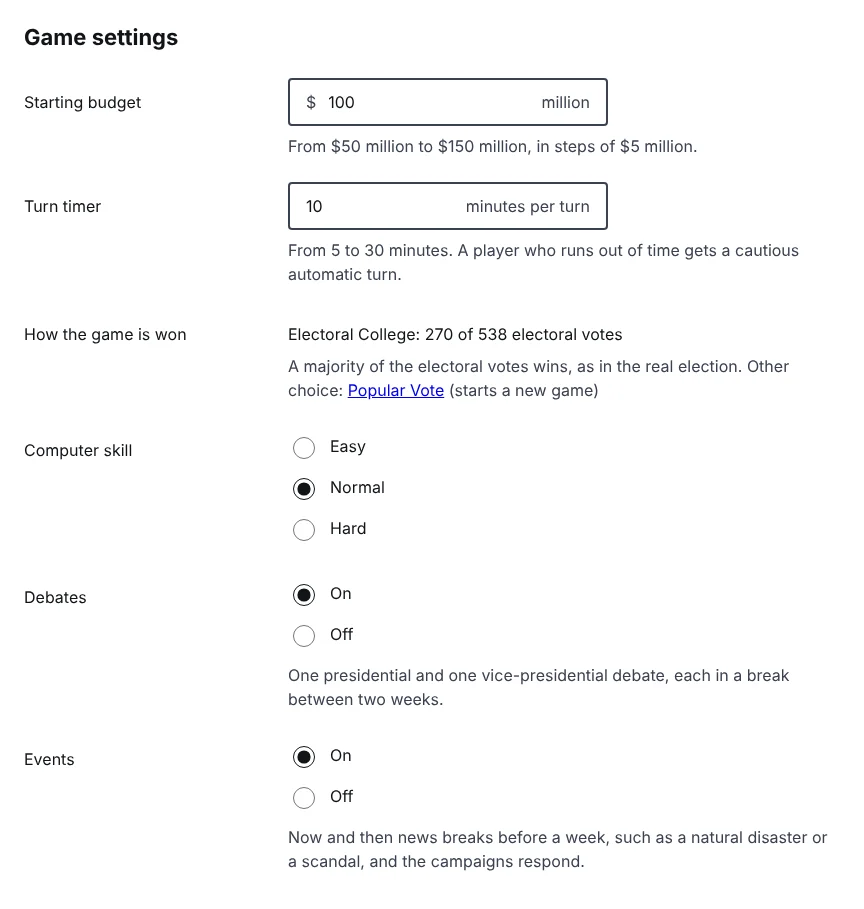
Set the money. Each campaign starts with anywhere from $50 million to $150 million. On a lean budget you decide which states to give up. On a rich one you can fight across more of the map, if you don't spread yourself too thin.
Hire your staff. Top advisors read the race more clearly and their teams get more out of every dollar, but their salaries come out of the money you'd spend on the race. Cheaper staff leave you more to spend and more to second-guess.
Decide how the race is won. In the Electoral College, a handful of close states decide it. In a popular-vote race, a vote in California counts as much as a vote in Ohio.
Let the unexpected in, or keep it out. With debates on, your candidates give up campaign time to prepare for questions nobody can predict. With breaking news on, a scandal or a disaster can upend a plan you've followed for weeks. Ask anyone who has worked on a campaign.
Choose who you're up against
The computer picks a strategy at the start of the game and doesn't tell you which. You read it from the polls and from where its candidates show up, then decide whether to meet it head on or go around it. Set how hard it plays: Easy, Normal, Hard.
A friend gets a link. You propose the settings, and your friend accepts or rejects them. From then on each of you plans in private, and all you see of the other campaign is where its candidates go and what the polls do.
Your own AI, such as Claude or ChatGPT, can run the other campaign. It plays by the same rules and sees only what a player in its seat would see. Find out whether it can out-manage you. How to play against an AI player explains how to connect it.

Free, in your browser
Play in a web browser on any computer or tablet with an internet connection: Windows, Mac, Linux, ChromeOS, iPad or Android. There's nothing to download and no account to create. Phones are too small for it.
It's a game for serious strategy players, not for passing the time while you wait for the barber's chair.